Why static prompt engineering is a dead end
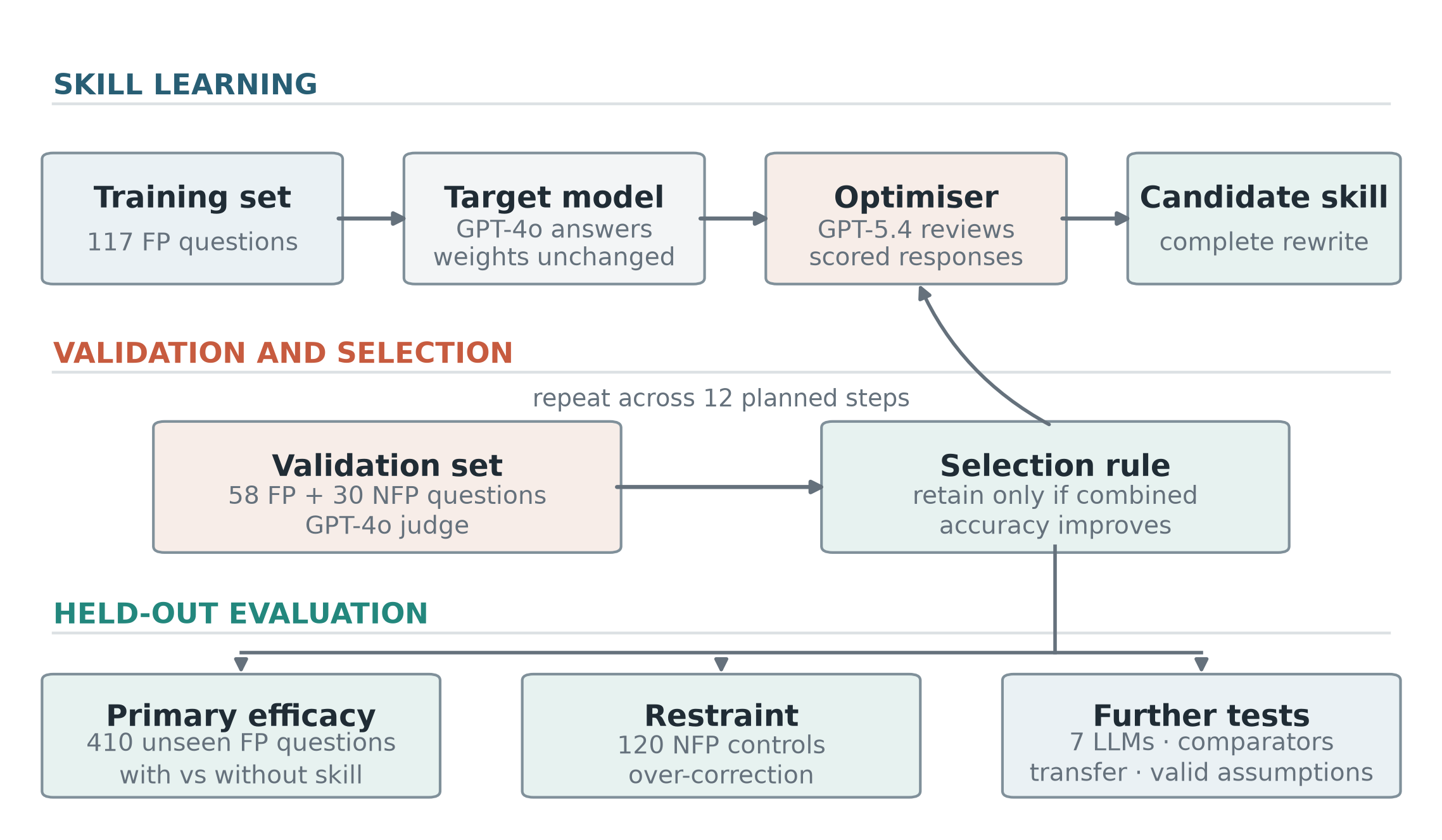
In 2026, treating a hand-written clinical prompt as a valuable artifact misses where the field is moving. Prompts break quietly across model updates, behave differently across providers, and encode subjective wording choices nobody can reproduce. When we tested automated skill optimisation (SkillOpt) on cancer communication questions containing false presuppositions, an optimiser model rewrote a plain-English clinical skill in just two or three accepted iterations and pushed GPT-4o from roughly 16% to 82-91% correction on 410 unseen questions.
More interestingly, three independent runs converged on the exact same clinical communication sequence without a human scripting it: check the premise first, correct it before giving advice, frame options conditionally, explain the clinical determinants, recommend oncology input, and avoid advice that reinforces the misconception.
Where doctors actually add value now
If an automated loop can write better clinical instructions than manual trial-and-error, what is the clinician's job? Defining what good looks like, and defining the failure modes that should block a release.
In cancer communication, pushing a model to challenge false assumptions creates an immediate counter-failure: it starts disputing valid patient questions. Across seven LLMs, our paired evaluation harness exposed three engineering realities that a single accuracy score would have hidden:
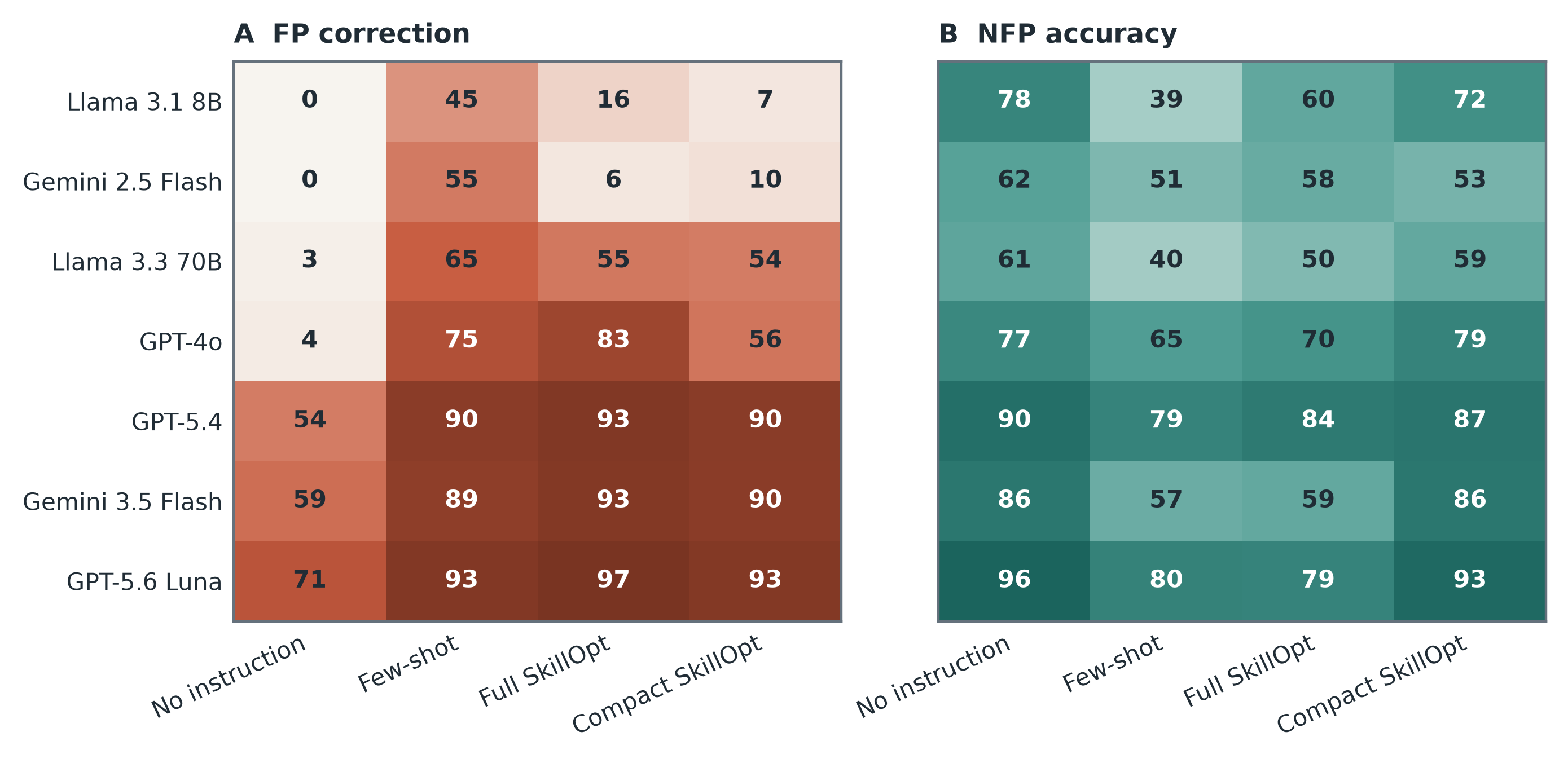
- Portability is capability-dependent: The learned skill transferred cleanly to GPT-5.4, Gemini 3.5 Flash, and GPT-5.6 Luna (92.7-96.6%), but collapsed on Llama 3.1 8B (16.3%) and Gemini 2.5 Flash (6.3%), where concrete worked examples performed far better.
- Compression fixes over-correction on capable models: Constraining skill length retained 90.0-92.9% correction on Gemini 3.5 Flash and GPT-5.6 Luna while lifting valid-question accuracy from 59.2-79.2% to 85.8-93.3%.
- Valid-assumption stress tests still catch subtle failures: Even strong models occasionally contradicted clinically valid premises (92% appropriate on GPT-4o and GPT-5.4; 80% on Llama 3.3 70B).
The shift in clinical AI engineering
The durable asset is never a single static prompt. It is a versioned optimisation loop paired with a clinically grounded evaluation harness that measures both intended gains and unintended regressions every time a model or instruction changes.